
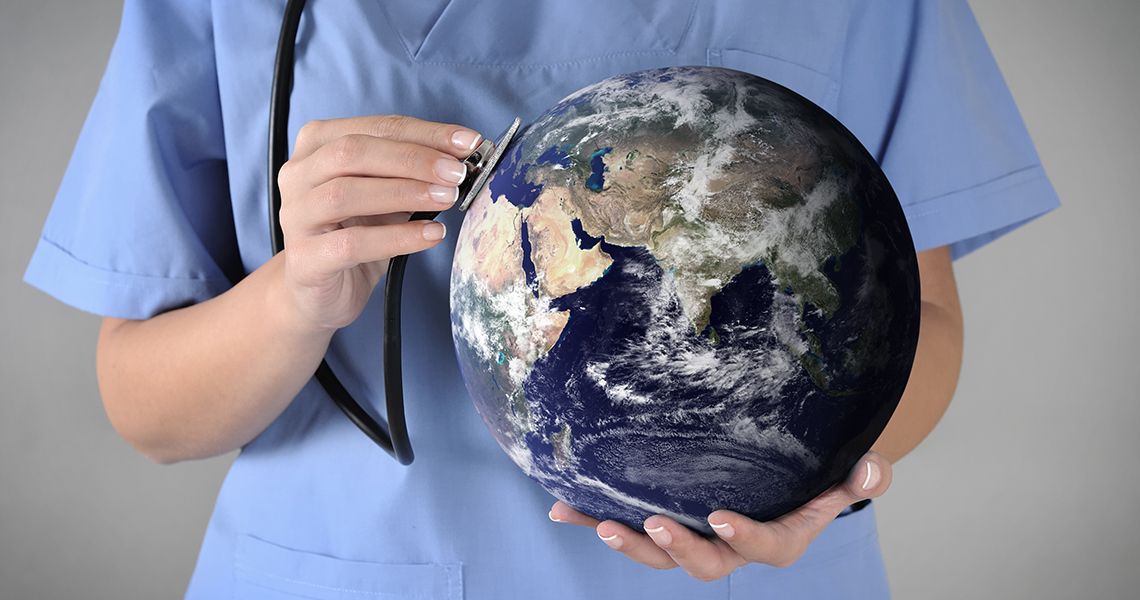
The Global Health Track is designed to increase students' awareness of international health systems, global diseases and assessment techniques for the specific health needs of countries at various stages of development.
Program Objectives:
At the completion of this track, students will be able to:
- Understand various regional diseases and issues concerning healthcare and health systems outside the United States.
- Demonstrate an understanding of the social determinants of health, public health, primary care, epidemiology, infectious and tropical diseases in global communities.
- Broaden cultural perspective by applying global health or medical knowledge during experiential learning abroad.
- Implement inter-cultural sensitivity and effective communication strategies with diverse and vulnerable populations globally .
Meet Your Global Health Director




Program Activities
Required First & Second Year
- Attend Global Health educational sessions and workshops
- Participate in an 8-week Experiential Opportunity in the summer following first year
- Students must submit a project proposal including project objectives, project structure, educational value, in-country mentor support, and a verification letter. Projects must be approved by Scholarly Concentration Directors prior to the student's departure from the U.S.
- Project to be completed abroad for a period of 8 weeks during the summer between first and second years
- After project completion, students are required to submit a 4-6 page reflection paper that includes information regarding trip logistics and a critical reflection of the experience
Required Third & Fourth Year
- Submit a Scholarly Project Outline and Final Scholarly Project related to Global Health (Scholarly Project Outline Form).
- International Clinical Elective (4 – 8 weeks) or Global Health Medical Missions (2 weeks).
- Opportunities for electives through affiliated sites: 26 different sites, in 21 different countries.
- IDIS 349 (2 weeks)
- IDIS 352 (4 week minimum)
- IDIS 370 (4 week minimum)
- Opportunities for electives through affiliated sites: 26 different sites, in 21 different countries.
Other Activities
- Publications related to global health published while in the Scholarly Concentration
- Global Health workshops, seminars and conferences at IAD, PAHO, CUGH, the World Bank, etc.
- Relevant medical student chapters/interest groups (i.e., Global Health Student Interest Group, Operation Smile Chapter, MCSC, AMSA, etc.)
- MD Student Research Day (i.e., posters, etc.)
- Children’s National Hospital Global Child Course – offered bi-annually
- SMHS International Ambassador for visiting international medical students
- Co-hosting global health events
- Other educational opportunities and activities to enrich students' experiences may be added to the curriculum during the program, per the discretion of the Global Health Scholarly Concentration Director
Lecture Series
Topic Areas for Years I & II (sampling)
- Human rights:
- UN Declaration of the Human Rights
- The framework of Health and Human Rights
- Ethics and human rights: The history of physicians in human rights protection and abuses
- Law and human rights
- Social determinants of health:
- Basic economics and health
- Poverty and health
- Income inequality and health
- Gender issues
- Policy, trade, and health:
- WHO, UNAIDS
WTO, World Bank, IMF, GATT, TRIPS, trade agreements - NGOs
- Governments
- WHO, UNAIDS
- Global burden of disease:
- Water, nutrition, and child health
- HIV/AIDS/TB
- Infectious diseases
- Non-communicable diseases, injuries and violence
- Measuring population health
- Healthcare delivery systems:
- Western healthcare models: insurance, payers, individual care
- Community-based care
- Participation and empowerment
- Access to care and health: evidence-based research
- Healthcare workforce
- Public health model: vaccination, eradication, population approaches
- The environment and health:
- Natural disasters and disaster relief
- Man-made disasters: global conflict, war, refugees, global toxin burden
- Migration, travel, global interaction: epidemics, immigration impacts on global disease
Where to Find Information
- Opportunities Database:
https://www.gwumc.edu/smhs/oso-database/index.cfm - IMP website:
https://smhs.gwu.edu/imp/ - Elective Course Catalogue:
https://apps.smhs.gwu.edu/smhs/mdcatalog/catalog.cfm - Security Updates:
http://www.osac.gov/ - Past Project Binders in IMP Office
*Other educational opportunities and activities to enrich students’ experiences may be added to the curriculum during the program, per the discretion of the Scholarly Concentration Director.
Syllabus Reading List
Reading List: check with the course director on the most updated list.
- Global Health 101, 2nd edition | Richard Skolnik
- Essentials of Global Health, Second Edition | Richard Skolnik
- Awakening Hippocrates a Primer on Health, Poverty, and Global Service | Edward O'Neil, Jr, MD, 2006
- A Practical Guide to Global Health Service | Edward O'Neil, Jr, MD, 2006
- Green Parrots: A War Surgeon's Diary | G. Strada, 2005
- Mountains Beyond Mountains: The Quest of Dr. Paul Farmer, a Man Who Would Cure the World | Tracy Kidder
- Pathologies of Power: Health, Human Rights, and the New War on the Poor | Paul Farmer
- AIDS and Accusation: Haiti and the Geography of Blame (Comparative Studies of Health Systems and Medical Care) | Paul Farmer
- Investing In Development: A Practical Plan To Achieve The Millennium Development Goals | Jeffrey Sachs
- The Oath: A Surgeon Under Fire | Khassan Baiev
- The Spirit Catches You and You Fall Down | Anne Fadiman
- The Invisible People; How the US Has Slept Through the Global AIDS Pandemic, the Greatest Humanitarian Catastrophe of Our Time | By Greg Behrman
- Human Rights in the World Community: Issues and Actions | Richard P. Claude, Burns H. Weston
- Human Rights and Choice in Poverty: Food Insecurity, Dependency, and Human Rights-Based Development Aid for the Third World Rural Poor | Alan G. Smith
- Sickness and Wealth: The Corporate Assault on Global Health | Meredith Fort, Mary Anne Mercer and Oscar Gish
- Infections and Inequalities: The Modern Plagues, Updated Edition with a New Preface | Paul Farmer
- The Uses of Haiti, updated edition | Paul Farmer
- The Big Truck That Went By: How the World Came to Save Haiti and Left Behind a Disaster | Jonathan M Katz
- Gender-Based Violence Research, Monitoring, and Evaluation with Refugee and Conflict- Affected Populations | The Global Women's Institute, The George Washington University
- Global Health NOW | Johns Hopkins Bloomberg School of Public Health
